英文讲解
English Tour Guide Script for China Armed Escort Agency Museum
Dear visitors, hello everyone! Welcome to the China Armed Escort Agency Museum.
The museum opened to the public in December 1999. It is located at No.61 South Street, Pingyao Ancient City, a UNESCO World Cultural Heritage Site. Covering a total floor area of over 1,700 square meters, this west-facing compound adopts a T-shaped layout, a typical architectural style of traditional Shanxi folk courtyards.
The museum houses 11 exhibition halls, showcasing the origin of armed escort agencies, their core businesses, scenes of bandit encounters on long-distance escort routes, the legendary stories of the escort industry, internal codes and disciplines, and the kitchen of an escort agency, among other themes.
First, let us reflect on the enlightenment brought by the demise of armed escort agencies.
Three Lessons from the Fall of Escort Agencies
1. Transformations always arrive faster than expected
Nowadays, driverless vehicles and unmanned logistics are heavily promoted everywhere. Many logistics practitioners and truck drivers feel these concepts are far from real life, believing the so-called logistics revolution is still distant. People tend to trust only what they see and dismiss promotional information as hearsay.
Yet if you look at your mobile phone, you can witness the astonishing speed of technological change. It only took 10 to 20 years for bulky brick mobile phones to evolve into modern smartphones, and merely a decade for mobile operating systems to shift from Symbian to Android. The average age of workers in today’s logistics industry is 35, meaning this transformation will most likely arrive before their retirement. The "wolf" of change is truly at the door.
2. Only those who embrace transformation can survive
The invention of trains and automobiles pushed horse-drawn carriages to the margins of transportation and rendered the ancient escort logistics system obsolete. Transformation is an irresistible force. When a new technology better meets social demands, people’s choices will ultimately follow objective, rational logic. You may admire the grace of horse riding, yet the countless cars crowding roads prove how thoroughly change reshapes society and people’s lifestyles.
Here is a more relatable example: Truck manufacturers have continuously upgraded vehicle designs over the years to cut fuel consumption, advertising fuel efficiency as a core selling point. Given two trucks of the same price, one consuming 30 liters per 100 kilometers and the other 28 liters, which would logistics companies and fleet operators choose? Transformations driven by technological upgrades alter the world subtly but profoundly. Change is like a speeding carriage: those riding inside head for a bright future, while those standing outside will either be struck down or left far behind.
3. Transformation does not equal extinction
When automobiles replaced horse-drawn carriages, coachmen panicked, fearing loss of their livelihoods — yet history later proved their anxiety unfounded. Many former coachmen became truck drivers or vehicle repairmen. The decline of one industry always paves the way for the rise of another, which generates new job demands. As long as workers adapt to emerging industries, they will not face unemployment.
Core Traits of the Armed Escort Industry
1. High risk with stringent professional requirements
Ancient escort agencies were tasked with transporting high-value goods or VIP clients. Long, rugged travel routes exposed escorts to bandit raids and sudden illness, making the job extremely dangerous: minor incidents meant lost cargo, while severe encounters could cost lives. This parallels the modern work of truck drivers. High risks demanded highly skilled practitioners.
First and foremost, every escort had to master martial arts. When confronting bandits, fighting was always the last resort. Escorts relied on secret jargon, communication and negotiation to defuse conflicts. Working as an escort was therefore a highly technical profession requiring specialized expertise. Similarly, today’s logistics firms and independent truck drivers must master professional skills in vehicle maintenance, fleet management and business development — professionalism equals competitiveness.
2. Mature industry norms and high moral standards among escorts
Drawing from decades of real-world experience, escort agencies formulated strict codes of conduct such as the Six Commandments of Escort Work and Three Prohibitions for Route Travel. These rules guaranteed orderly, secure escort missions. Beyond martial prowess, agencies imposed rigorous moral standards on all staff. An outstanding escort needed not only combat skill but also integrity, loyalty and rectitude. They bore full responsibility for delivering consignments safely; failure to do so brought devastating losses to the agency and ruined the escort’s reputation across the trade. Throughout the history of escort agencies, cases of escorts stealing entrusted valuables were extremely rare, a testament to their outstanding moral character.
As an old saying goes: nothing can be accomplished without norms or standards. Many persistent problems in the modern logistics industry stem from poor personal ethics among practitioners. While government regulatory policies are essential, establishing self-governing industry codes, much like those of ancient escort agencies, is equally vital. Industry insiders often blame systemic flaws rather than reflecting on their own moral conduct, yet every industry is defined by its people. A workforce that disregards rules will inevitably create a chaotic sector.
Take cargo overloading as an example. Everyone acknowledges it is unsafe and abnormal, yet many drivers take pride in overloading, even competing to carry heavier loads. The excuse "everyone else overloads; I cannot make a living otherwise" normalizes this dangerous practice, trapping all participants as both perpetrators and victims. This is the bitter fruit of ignoring industry rules. While criticizing insufficient government supervision, actively rejecting unethical industry practices is the greatest contribution one can make to the sector.
Escort agencies rose to meet the commercial demands of their era, flourished thanks to standardized professional practices, and vanished when they could no longer keep pace with societal progress. We study history to avoid repeating past mistakes and inherit valuable ancient wisdom. This comparative analysis illustrates that the logistics industry is undergoing profound transformation and will inevitably move toward standardized, sustainable development. History has delivered its verdict — no one can escape its laws.
In the narrow sense, an armed escort agency was a specialized private security firm serving merchants and individuals. In the broad sense, it was an early form of insurance that charged fees to transport silver bullion and precious cargo. The boom of Pingyao’s exchange shops (piaohao) in the mid-Qing Dynasty fueled the rapid expansion of the escort trade.
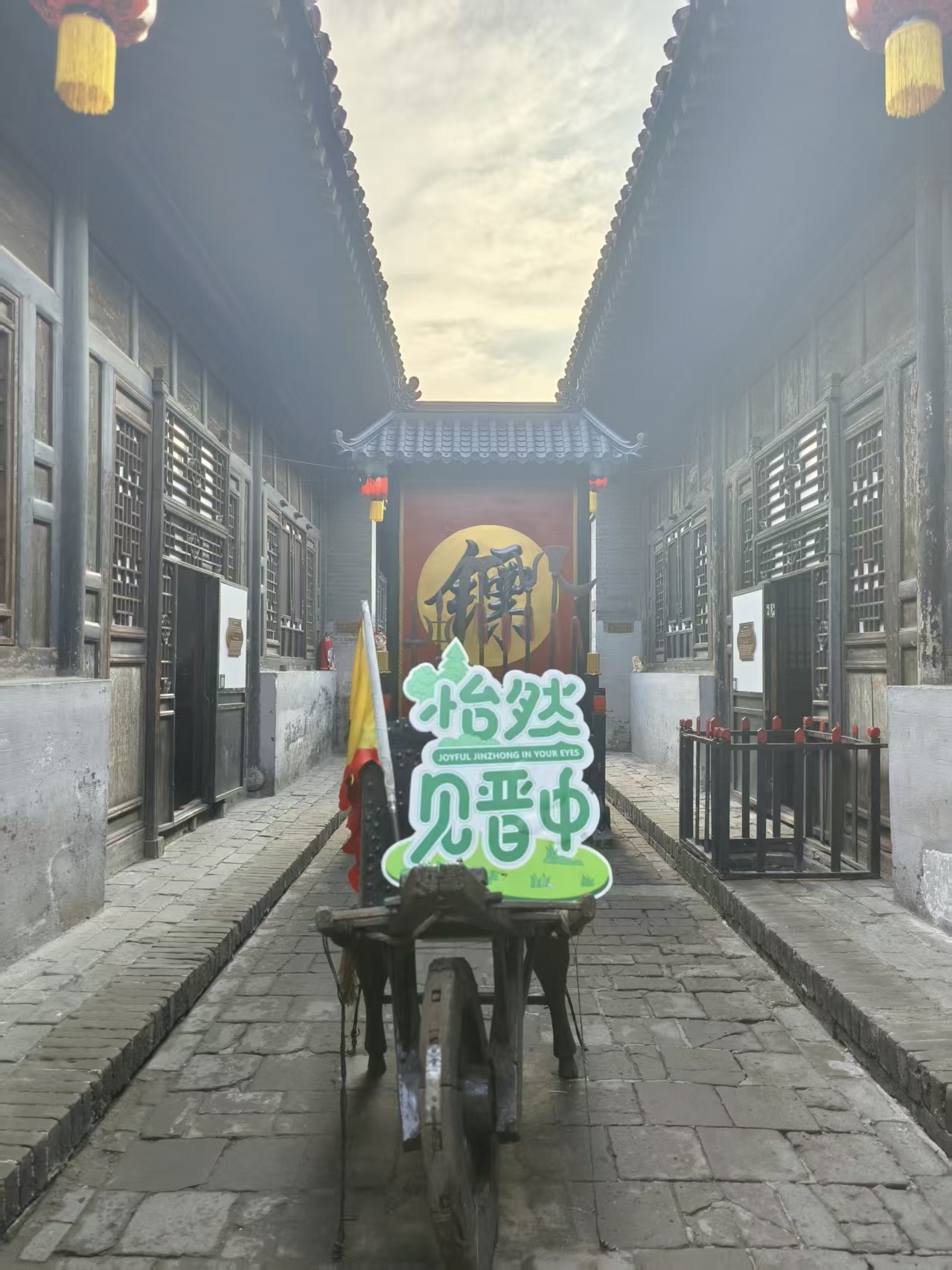
Here we display the Three Treasures of an Escort Agency: the escort cart, escort chest and escort flag.
This single-wheel escort cart is quite distinctive. Designed for rugged mountain trails, it demands excellent balance to operate. There is a folk trick to pushing it: To make the cart roll, sway your hips. Master balance, and you are ready to hit the road.
The triangular escort flag bears the surname of the head escort; this one bears the character "Wang", representing the agency founded by Wang Zhengqing. When bandits spotted the surname on the flag and recognized the master’s formidable reputation, they would usually abandon any robbery attempt.
Escort chests were carved from elm wood, weighing 70 jin each, wrapped in cowhide to resist water and moisture.
This vault reaches 2 meters deep and could store up to 800,000 taels of silver. Strategically built right by the main gate, it follows the counterintuitive logic: the most conspicuous spot is the safest. In ancient times, it was concealed beneath wooden planks and piled sundries to avoid detection.
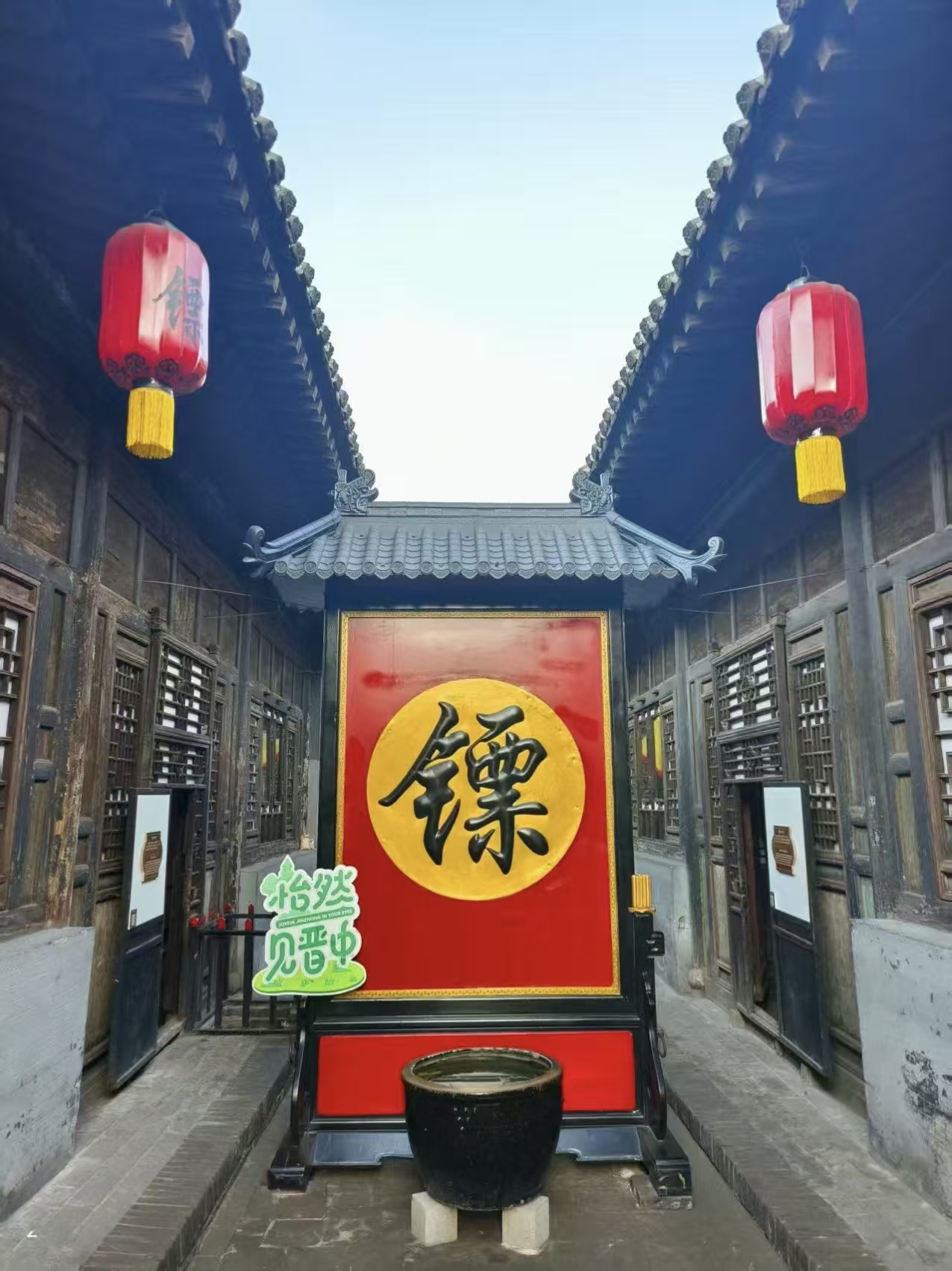
Let us examine the Chinese character "biao" (escort). Originally written as "biao" without the gold radical, it gained the metal radical during the late Qing Dynasty with the rise of exchange shops. The gold radical symbolizes the eighteen weapons of martial arts, while the right component stands for exchange shop silver. Together, the character means safeguarding silver with military force. The yellow base color evokes Shanxi’s Loess Plateau, as most escorts traveled overland rather than by river. The red border wishes the agency thriving, prosperous business.
Exhibition Room 1 — The Origin of Armed Escort Agencies
An armed escort agency, also called biaohang, was a private security service that accepted payment and used martial arts to protect clients’ property and personal safety. Historians hold two theories regarding its founding: one traces its birth to the Zhengde reign of the Ming Dynasty, the other to the Qianlong reign of the Qing Dynasty.
Its prototype was the dahang (bodyguard guild) of the Ming Dynasty, an identical service that charged fees for personal and cargo protection. In ancient times, poor transportation made long-distance travel arduous and fraught with bandits, spawning the bodyguard trade and formal escort agencies. During the Qianlong reign of the Qing Dynasty, Zhang Heiwuyi, a famed Shanxi martial artist known as the Divine Fist, established Xinglong Escort Agency outside Beijing’s Front Gate — China’s first official armed escort agency.
Escort agencies were founded by three groups: martial arts enthusiasts, hereditary martial clans, and demobilized soldiers.
1. Agencies founded by martial arts enthusiasts
Several practitioners first formed loose groups to exchange and refine combat skills, mostly fellow disciples with shared martial lineages, even if trained under different masters. These agencies prioritized camaraderie, distributing shares evenly with equal standing for all members, who all held a voice in collective decisions.
2. Agencies founded by hereditary martial clans
Staff shared blood or kinship, bound by family loyalty and a heroic spirit of standing together through life and death. Though outsiders were hired later, clear gaps in status and share allocation separated clan members from hired hands, who existed under a standard employer-employee contract.
3. Agencies founded by demobilized soldiers
After military downsizing, many veterans received no official resettlement. Disciplined, loyal and bound by military ethics, they left service penniless with only their combat skills to sustain them, banding together to open escort agencies. United by the core value of righteousness, they had fought side by side on battlefields and shared hardship equally on escort routes.
Four Preconditions for the Emergence of Escort Agencies
1. Official approval and endorsementAs civilian armed groups and unique commercial entities, escort agencies were strictly banned by authorities in the early Qing Dynasty. Only during the prosperous Qianlong era, driven by booming commercial demand, did the government legalize their operation.
2. Grassroots martial arts communities
Escort agencies could not exist without established folk martial groups. Their strict master-disciple hierarchies and extensive social networks allowed newly founded firms to gain rapid public trust.
3. Surge of long-distance interregional trade
Mid-Ming China saw the germination of capitalism and flourishing domestic commerce. In the Qing Dynasty, northern border trade became an economic hub, creating market demand for long-distance cargo security services.
4. Demand for bulk silver and freight transport
Border trade in early Qing brought immense wealth to Shanxi merchants, yet the dangerous long-distance shipment of goods and silver severely restricted their business growth — this urgent security need directly gave rise to escort agencies.
Exhibition Room 2 — Core Businesses of Armed Escort Agencies
There were six categories of escort missions:
1. Mail Escort: Delivery of private letters
2. Goods Escort: Long-distance transportation of merchandise
3. Silver Escort: Guarding silver bullion for government bodies and merchants
4. Grain Escort: Transporting grain for official and commercial clients
5. Draft Escort: Conveying silver funds, letters and bank drafts for piaohao exchange shops
6. Personal Escort: Protecting clients’ personal safety
The most famous personal escort mission occurred in 1900. When the Eight-Nation Alliance invaded Beijing, Empress Dowager Cixi fled to Xi’an and passed through Pingyao. Wang Shumao, son of Wang Zhengqing, escorted and safeguarded her along the journey.
Three Styles of Overland Escort Operations
1. Prestige Escort (Weiwu Biao)
A tall flag printed with the head escort’s name was mounted on the cart and hoisted fully to the top, known as the full-top flag. Escorts shouted resonant work chants or the agency’s famous moniker to broadcast their identity — this practice was called "displaying escort prestige". It warned bandits to assess their strength and retreat if outmatched. Only powerful, well-connected agencies with strong reputations adopted this method.
2. Benevolence Escort (Renyi Biao)
The escort flag was lowered halfway. Escorts beat special bronze gongs: the Thirteen Taibai Long Mallet Gong, Five-Star Gong or Seven-Star Gong. This gesture conveyed humility to fellow outlaws: "We lower our status first; we ask all heroes of the rivers and lakes to grant us passage."
3. Secret Escort (Anbiao)
When traversing hostile territories ruled by unyielding bandits who could not be defeated, escorts traveled silently: bells were removed from horses, carriage axles greased for quiet movement, and all flags stowed to slip past undetected. A well-known rule of this custom was: No escort chants when passing Cangzhou. In the late Qing Dynasty, all escort carts took down their flags and traveled silently through Cangzhou, never calling out their agency’s name to avoid disaster. The origin of this tradition is recorded in Comprehensive Compendium of Martial Arts: "Cangzhou has long nurtured countless peerless martial arts masters."
Three Core Codes of Conduct for Escorts Before Departure
All escorts abided by three maxims before setting off: Wear a faint smile, yield half the argument, drink only one-third of a cup of wine.
Though navigating the dangerous underworld, escorts upheld harmony above all. They avoided reckless vendettas, remaining modest and courteous: respecting elders and treating talented people with humility, bearing the demeanor of refined gentlemen. They compromised readily to avoid conflict. Only senior escorts were permitted alcohol, and merely a small amount — excessive drinking invited fatal danger on the road.
Three Essential Skills & One Non-Negotiable Taboo ("Three Masteries, One Forbidden Act")
Three Masteries
1. Build makeshift stoves: Travel routes rarely featured inns; escorts often camped outdoors and needed to cook independently.
2. Mend footwear: Long journeys demanded well-fitted shoes. New footwear bought en route seldom fit perfectly, so shoe repair was a vital survival skill.
3. Cut hair and groom: Trips could last months in harsh wilderness. When entering villages or towns to meet local dignitaries, proper grooming showed respect, preserved the agency’s dignity and demonstrated its strength.
One Forbidden Act: Never Wash One’s Face Mid-Mission
Two key reasons underpinned this custom:
1. In escort jargon, "washing one’s face" signaled mission completion and homecoming. Washing mid-journey was deemed a terrible omen.
2. Facial grime formed a natural barrier against harsh sunlight and ultraviolet radiation, much as travelers in Tibet avoid morning face-washing to shield skin from intense UV rays. Escorts only thoroughly washed their faces once their assignment concluded. Thus, film and television depictions of spotlessly clean-faced escorts are historically inaccurate.
Three Rules for Riverine Escort Missions
For waterway travel, escorts followed three strict regulations: Never leave the vessel, sleep by day and stand guard at night, and maintain respectful distance from women aboard.
1. Sleep by day, stand watch by night: All escorts except the on-duty sentry slept deep in the cabin through daylight. Bandit raids occurred almost exclusively after dark, requiring full vigilance from sunset onward.
2. Never leave the boat: Canal towns and markets lined the waterways, lined with teahouses, taverns, street performers, opera troupes and pleasure boats carrying courtesans. Escorts never went ashore to watch performances or chase thieves on land, fearing diversionary bandit tactics that would leave cargo unguarded.
3. Show deference to women: Boat families lived aboard with their wives and daughters. While boat women were perceived as relatively free-spirited in feudal society, escorts upheld strict martial ethics, and all women aboard observed traditional moral standards of self-respect.
Pre-Departure Rituals for All Escorts
1. Take a thorough bath: They would not wash their faces for weeks on the road, so a full bath was mandatory before departure.
2. Settle all family affairs: Every escort prepared for the possibility of never returning alive amid constant roadside danger.
3. Pay homage to Guan Gong (Lord Guan). Guan Yu embodied loyalty, trust, faithfulness and bravery: he upheld his oath to Liu Bei through hardship, rejected titles and wealth under Cao Cao, and rode a thousand li to rejoin his sworn brother. Born in 160 AD and deceased in 219 AD, Guan Yu spent nearly sixty years fighting to establish the Three Kingdoms. Later generations revered him as the paragon of loyalty, integrity, righteousness and courage — virtues all escorts strove to emulate.
Three Non-Negotiable Rules While Traveling ("Three Never Leave")
At all times, whether on the road or lodging at inns:
1. Weapons must stay on one’s person for instant defense against ambush.
2. Outer garments cannot be removed.
3. Carriages and pack horses must remain within the inn courtyard.
These rules allowed escorts to react instantly to sudden threats.
Three Types of Inns Escorts Strictly Avoided ("Three No-Stay Inns")
When stopping overnight, three kinds of inns were off-limits:
1. Newly opened inns: Unknown owners and staff created unquantifiable risk; any inn displaying "Grand Opening" signage was shunned.
2. Inns under new management: Changed proprietors raised suspicion of colluding bandits.
3. Inns housing courtesans: Seductive women were known to distract escorts and create opportunities for thieves to seize consignments.
Three Mandatory Safety Inspections After Checking Into an Inn
After securing lodging, escorts conducted three thorough checks:
1. Check for suspicious occupants: Patrol all rooms to confirm no bandits share the premises.
2. Check for suspicious followers: Circle the exterior to verify they are not being tailed.
3. Check for strange odors: Inspect the kitchen to rule out poisoned food or drink.
Exhibition Room 3 — The Thousand-Mile Escort Trail
Escort routes stretched north to the frontier desert and south to the Yangtze-Han river coast, combining overland and riverine travel that was both grueling and perilous. This hall recreates the authentic scene of ancient long-distance escort missions.
When escorts encountered known bandits on the trail, they would shout the traditional rallying cry: One cry of "hewu" sends the cart forth, half a year of safe travel across the rivers and lakes.
Wuxia novels and films romanticize escorts as lone heroes wandering the underworld, defeating bandits with unmatched martial arts, enduring solitude in remote mountain inns, performing chivalrous deeds and earning gratitude from traveling merchants. Yet the real life of an escort was far harsher: entrusted with tens of thousands of taels of silver, they traversed isolated, rugged mountain valleys and lengthy river routes, unable to remove their clothes to sleep, forbidden from washing their faces, and never parting with their weapons, constantly on guard against robbery and theft. Missions often dragged on for months or even years, demanding endurance beyond ordinary people’s capacity. Only those with extraordinary courage and formidable martial arts dared take up this profession — this is the unvarnished reality of an escort’s life.
Much like the Communist Party of China, escorts endured victory and setback, triumph and hardship, fortune and adversity. No enemy or hardship could break their resolve; tempered by countless trials, their spirit only grew stronger.
Exhibition Room 4 — Secret Underworld Jargon (Chun Dian)
Chun Dian refers to the secret code words used by escorts and outlaws to communicate. When meeting familiar bandits, escorts exchanged greetings to build rapport for future truces. When encountering unfamiliar bandit leaders, a successful exchange of secret jargon would prompt the bandit chief to shout "hewu" and grant passage. If the code words did not match, a violent fight would erupt. For this reason, every escort settled all family affairs before departure, preparing for potential fatal encounters.
Sample dialogue between bandits and escorts:
Bandit: "What a fine pool of water!" (Your cart carries abundant valuables.)
Escort: "No fish swim in this pool." (We bear no treasure worth stealing.)
Bandit: "This pool swarms with fish!" (Your cargo is extremely valuable.)
Escort: "Every fish bears sharp spines." (Our martial arts make this treasure hard to seize.)
Bandit: "We pull out and depart." (We withdraw.)
The shrine here honors the Waterway Guanyin (Free and Easy Guanyin), whom escorts worshipped before riverine voyages to pray for safe passage.
Escort Carrier Pigeons
Specially bred and trained carrier pigeons maintained communication between an agency’s head office, branch offices and traveling escort teams during emergencies.
Escort Guard Dogs
Trained guard dogs accompanied all escort parties as vital assistants, patrolling for danger and sounding the alarm at the first sign of bandits.
Exhibition Room 5 — Legends of Famous Escort Agencies
Xinglong Escort Agency
China’s first official escort agency, founded by Zhang Heiwuyi of Shanxi, known as the Divine Fist. He served as martial arts tutor to Prince Damowang, who persuaded the Qianlong Emperor to authorize the nation’s first state-sanctioned escort agency outside Beijing’s Front Gate. Zhang’s son Zhang Huaiyu inherited the business. The traditional rallying cry One cry of "hewu" sends the cart forth, half a year of safe travel across the rivers and lakes derives from Zhang’s nickname "Heiwuyi", with "hewu" as its homophone.
Huiyou Escort Agency
Ranked among the top ten Qing-Dynasty escort agencies, located on South Grain Shop Street at the east entrance of Dashilan outside Beijing’s Front Gate. Founded by Song Yanchao, master of the Three Emperor Cannon Punch. In the 25th year of the Daoguang reign, Song joined the Imperial Firearms Battalion, yet witnessing corrupt court governance led him to resign and establish Huiyou. The agency guarded Li Hongzhang’s private residence and grew to employ over 1,000 staff at its peak, the largest of its era.
Changlong Escort Agency
Founded by Zuo Erba in the 20th year of the Daoguang reign. Its predecessor, Yuyong Escort Agency, was established by Zhang Demao, nicknamed Elder Long Eyebrow, Zuo’s martial arts master. Impressed by Zuo’s talent and integrity, Zhang transferred the agency to him. At its peak, Changlong employed over 100 staff and opened branch offices in Hangzhou and other cities. Having escorted imperial consignments, its founder received an imperial yellow mandarin jacket from the Daoguang Emperor. The agency ceased operation in the 3rd year of the Xuantong reign amid the 1911 Revolution.
Wantong Escort Agency
Established in Baoding, Hebei Province, in the 17th year of the Guangxu reign by Li Cunyi.
Yuyong Escort Agency
Founded in the Jiaqing reign by Zhang Demao of Cangzhou, Hebei. His maternal grandfather was a renowned Kangxi-era martial artist known as the Divine Fist Tutor. After mastering combat under his grandfather, Zhang opened Yuyong Escort Agency in Suzhou, accepting Zuo Changde as his disciple. Impressed by Zuo’s skill and virtue, Zhang transferred the agency to him, renamed Changlong Escort Agency.
Guangsheng Escort Agency
Founded by Dai Erlü, heir to a hereditary martial clan in Qi County.
Chengxing Escort Agency
of China’s most famous escort agencies, founded by Li Guanming at age 32 in Cangzhou, Hebei. The ancient rule No escort chants when passing Cangzhou originated with Li Guanming, its first master.
The Origin of "No Escort Chants When Passing Cangzhou"
Cangzhou was a hub of martial arts talent, home to countless formidable escorts with far-reaching reputations. Out-of-town escorts muted their rallying cries upon entering Cangzhou to show respect to local masters and avoid unnecessary conflict. As the saying goes, "A mighty dragon cannot subdue a local snake" — even highly skilled outsiders risked public humiliation in a confrontation with Cangzhou’s warriors. Over time, this evolved into an unwritten underworld code.
A second legend attributes the rule to Li Guanming, born to a martial clan in Mengcun Town, Cangzhou, whose nephew Li Fenggang trained Wang Zibin, known as Big Sword Wang Wuyi. Li Guanming possessed extraordinary strength and a fiery, unyielding temperament. Once, a passing escort party shouted their rallying cries outside his residence, enraging Li. He declared: "Escorts must defeat local martial artists before shouting their chants here — to do otherwise is an insult to Cangzhou’s fighters." Li rode out to overtake the cart, seized the city gate with both hands, lifted a rearing horse between his thighs, suspending it mid-air. The terrified escorts begged mercy. Li had no intention of robbing them, merely to teach them a lesson, then laughed and departed. Word spread rapidly, and all subsequent escorts silenced their chants upon entering Cangzhou, cementing the enduring underworld rule.
Yuanshun Escort Agency
Founded by Wang Zibin, universally known as Big Sword Wang Wuyi for his signature large broadsword and birth order as the fifth son. A legendary chivalrous figure, he ranks alongside Swallow Li San, Huo Yuanjia and Wong Fei-hung. Two acts earned him eternal renown: supporting the Hundred Days’ Reform, and fighting foreign invaders outside Beijing’s Front Gate during the Eight-Nation Alliance invasion, where he was fatally shot.
Dashengkui
Founded by Wang Xiangqing of Taigu and Zhang Jie of Qi County at Shahu Pass in Youyu County, Shanxi, initially named Jishengtang before relocating to Guihua City (modern Hohhot) and renamed Dashengkui. It dominated cross-border trade with Mongolian grasslands. As local escort agencies lacked familiarity with Mongolian tribal territories, all grassland security contracts were outsourced to Dashengkui, earning it the moniker "the escort agency that was not formally an escort agency".
Sanhe Escort Agency
Founded by An Jinyuan of Dongyang Town, Yuci, Shanxi, and located in Zhangjiakou, Hebei.
Exhibition Room 6 — The Dignity of Legendary Escorts
The ten most celebrated ancient escorts were:
1. Li Guanming, creator of the "No escort chants when passing Cangzhou" rule
2. Li Fenglan, master of double broadswords
3. Che Yonghong, grandmaster of Xingyi Quan
4. Dai Erlü, preeminent Xingyi master of North China
5. Wang Zhengqing, revered as the Flour King of North China
6. Zuo Erba, master of Iron Leg techniques
7. Wang Zibin (Big Sword Wang Wuyi)
8. Li Cunyi, single-sword master
9. Zhao Guangdi, champion of free combat
10. Li Yaochen, consummate all-round martial artist
Wang Zhengqing, Zuo Erba and Dai Erlü are hailed as the Three Heroes of North China. A popular folk rhyme records their fame:
Wang’s spear, Dai’s fist, Zuo’s kicking techniques travel all under heaven;
Backed by the Daoguang Emperor, they conquer every foe without rival.
Wang Zhengqing and the Daoguang Emperor shared the same martial arts master, so his agency never lost a single consignment, boasting an impeccable reputation.
The shrine here honors Guan Gong, worshipped by all overland escorts to pray for safe travel. Guan Gong represents loyalty, righteousness, trust and bravery, serving as an internal moral restraint for all escorts. An outstanding escort needed unmatched martial prowess alongside integrity and rectitude, bearing full responsibility for safe consignment delivery. Failure brought ruin to the agency and permanent professional disgrace, explaining why theft by staff was almost unheard of across 300 years of escort history. This is the core reason for worshipping Guan Gong.
Biography of Wang Zhengqing (1801–1877)
Born in Nanliangzhuang Village to an impoverished family, Wang only received two years of private schooling in childhood. Frail in youth, he took up martial arts to strengthen his body, soon developing an all-consuming passion and robust physique.
In the 21st year of the Jiaqing reign (1816), he traveled to Beijing to work in a flour mill out of financial necessity, kneading dough for a living. He repurposed the heavy rolling pole as a spear, integrating combat training into labor, able to deliver hundreds of powerful thrusts without fatigue. His extraordinary arm strength earned him the nickname the Flour King among Beijing townsfolk.
One day outside Front Gate, a high-ranking official’s sedan procession blocked the road. A guard lunged at Wang with a spear, which Wang snapped in half with a subtle wrist maneuver. When other soldiers swarmed him, he disarmed all attackers with open palm strikes. The official intervened to halt the brawl, praising Wang’s unmatched skill and recommending him to Liu Liu, a revered Beijing spear master nicknamed Great Spear. Wang trained relentlessly under Liu for three years, mastering ten leg routines, six great spear forms and the Mad Demon Spear. Liu later introduced Wang to his senior disciple Jia Diankui, a native of Yongnian, Hebei, who taught martial arts to the Daoguang Emperor within the imperial palace. Recognizing Wang’s solid foundation and sharp insight, Jia recruited him as an imperial bodyguard with an annual salary of 200 taels of silver.
Over five years, Wang learned eight authentic Xin Quan routines, eighteen Shaolin free combat forms, ten hand-to-hand sets, paired spear and fist drills, seventy-two divine joint-locking techniques, Five Tiger Gate-Chopping Broadsword, Tiger Head Hook, Three-Section Whip, White Ape Staff and Spring and Autumn Broadsword. He then studied for three years under Chang Yi, master of internal boxing and combat theory, uniting internal and external martial arts styles to achieve complete mastery.
In the 11th year of the Daoguang reign (1831), Wang was hired as martial arts tutor by Prefect Wen of Jiangxi. In the 17th year (1837), he followed Wen to Henan Province, where rampant banditry plagued the region. Dispatched to capture a fugitive gang leader, Wang traveled unarmed with only one disciple, Feng Jinshan, and killed the bandit chief single-handedly, catapulting his fame across Henan. A direct descendant Shaolin grandmaster traveled incognito to challenge him and was defeated. The monk begged to become Wang’s disciple, yet Wang declined: "You are the orthodox heir to Shaolin boxing, renowned across the world. If you study under me, the Shaolin lineage will perish. I dare not accept you as a pupil, yet we may become lifelong brothers." The two forged an unbreakable friendship, and the Shaolin grandmaster erected a stone stele in Wang’s honor at Shaolin Temple to praise his martial virtue.
In the 20th year of the Daoguang reign (1840), Wang accepted an invitation from his senior brother Zhang Zhengshan to tutor his nephew. In the 24th year (1844), he taught martial arts in Zhu Family Village, Suning County, Hebei, accepting Du Laobu as his disciple. In the 28th year (1848), he retired from tutoring and returned to Pingyao.
In the 5th year of the Xianfeng reign (1855), Wang founded Tongxinggong Escort Agency within Pingyao Ancient City. Throughout his career as an escort master, he continued to exchange combat skills with fellow practitioners. Li Luoneng, famed as the Northern Divine Fist and master of internal Xingyi Quan in Taigu, initially doubted Wang’s skill, yet after a friendly sparring session where Wang executed fluid footwork and horizontally swept his long queue with effortless agility, Li expressed profound admiration. The two became lifelong friends, arranging regular cross-training between their disciples for decades.
Wang Zhengqing passed away in the 3rd year of the Guangxu reign (1877), and his son Wang Shumao inherited Tongxinggong Escort Agency, which ceased operation in the 2nd year of the Republic of China (1913).
Exhibition Room 7 — Tongxinggong, Famous Across the Nation
Tongxinggong was Pingyao’s sole armed escort agency. Wang Zhengqing earned the title Flour King, and his son Wang Shumao surpassed his father’s skill, cementing Tongxinggong’s national renown upon its founding. The hit immersive stage play Seeing Pingyao Again draws its central plot from the agency’s history.
This hall served as the formal reception lounge, where the agency hosted elite clients and negotiated major business contracts.
Three Models of Operational Relationships Between Head Office, Branch Offices and Local Satellite Offices
1. Satellite offices operate as extensions of branch offices, and branch offices as extensions of the head office; all finances are centrally managed by the head office.
2. Satellite offices, branch offices and the head office function as joint venture partners, operating independently with separate profit and loss accounting.
3. Head office, branch offices and satellite offices share investment ties, jointly bearing operational risks.
Internal Code of Conduct for Tongxinggong Escort Agency
- Between master and apprentice: Honor the master, care for disciples, avoid idle gossip.
- Between fellow disciples: Respect and accommodate one another, learn from each other’s strengths.
- Between staff and clients: Treat all guests warmly, reject fraud and exploitation.
- Upon accepting a consignment: Conduct thorough inspections, record all details clearly.- While escorting cargo: Remain vigilant, fulfill all duties conscientiously.
- Upon delivering consignments: Recheck all goods, collect signed confirmation.
Exhibition Room 8 — The Secret Vault
Vaults stored silver bullion temporarily during escort missions. Per signed contracts, agencies bore full financial liability for any lost cargo, so vault management followed extremely strict regulations:
1. Vault staff only; all other personnel prohibited from entry.
2. Vault guards forbidden from leaving their posts without permission.
3. Only the head escort may retrieve silver funds.
This hollowed log cylinder is called a qiao, holding up to 1,000 taels of silver, disguised as ordinary lumber to avoid bandit suspicion during transport.
Exhibition Room 9 — Agency Rules and Apprenticeship Culture
Next, we explore the traditional apprenticeship rituals of escort agencies. A high-risk, high-reward trade, escort work demanded mastery of all eighteen weapons plus exclusive family combat techniques, closely guarded secrets never shared with outsiders. Our agency’s founder Wang Zhengqing specialized in spear combat, making the choice of a skilled master life-changing. The elaborate apprenticeship ceremony preserves precious traditional Chinese etiquette worthy of study.
The apprenticeship ritual consists of six core steps:
Step 1: Pay homage to Patriarch Bodhidharma
Chinese martial arts divide into southern soft fist styles and northern hard leg styles, with northern combat originating at Shaolin Temple. Bodhidharma is revered as the founding ancestor of all martial artists, so every apprentice must offer formal respect.
Step 2: The apprentice kowtows to the master
Etiquette governs every movement in ancient China, the embodiment of inner cultivation and moral character. The apprentice performs the grand rite of three bows and nine kowtows.
Brief cultural explanation: Traditional Chinese Taoism prioritizes yin-yang numerology; odd numbers represent yang, even numbers yin. Nine is the highest yang number, hence the title "Son of Heaven with Nine-Five Status" for emperors, while three is the foundational yang number — commoners built three-bay houses with three front steps to avoid overstepping social hierarchy. This grand ceremony was originally reserved for worshipping deities, later adopted for subjects paying homage to emperors, sons to fathers, and disciples to masters. One full bow consists of kneeling, prostrating and three head taps to the ground; three bows with three taps each form three bows and nine kowtows.
Step 3: Read aloud the apprenticeship contract
Also known as the disciple pledge, this document formed a life-or-death bond between master and apprentice, treated with the utmost gravity by both parties.
Apprenticeship Pledge Text
The role of a master holds immense significance.
Entering the sect to learn a craft provides the means to feed one’s family, a tradition passed down through generations with solemn ritual.
Today, [Apprentice’s Full Name] willingly swears discipleship to [Master’s Full Name], committing to [X] years of training and [X] years of service to the master upon graduation.
During training, the master shall provide all food and clothing. Though master and apprentice are distinct titles, their bond equals that of father and son.
The apprentice shall show unwavering reverence to the master, never forgetting lifelong teachings. This oath comes from the heart, with no room for regret or renunciation.
Words alone carry no weight; this written pledge bears witness to our solemn agreement.
Dated: Month X, Year XXXX
Pledge Explanation
The bond between master and apprentice mirrors father and son, hence the maxim "One day as your master, a lifetime as your father." The master imparts a livelihood skill to feed the apprentice’s family, a fundamental generational tradition with grand ceremonial customs. Historically, apprentices trained for three years, during which the master covered all living expenses — a local Pingyao folk saying describes teenage boys as "big eaters who drain their elders’ resources", a reminder of how fortunate it was to secure apprenticeship. Once the pledge is signed, the apprentice owes lifelong respect to the master and fellow disciples, internalizing all teachings without complaint. This written contract upholds the core Chinese virtue of integrity.
Step 4: Recite the Agency’s Core Disciplinary Code
As nations abide by law and families follow rules, escort agencies enforced strict internal codes, recited aloud to all new recruits:
All new followers shall heed the supreme command;
Within our sect, all brothers obey the master’s word.
The courtyard shall remain closed to irrelevant outsiders;
All agency members stand equal, ordered by seniority.
No recruit shall be accepted with unresolved legal disputes or tainted family background — depart at once if your affairs remain unsettled.
Actors, opera performers, street musicians, foot masseurs, opium pipe cleaners and barbers are ineligible for discipleship, unless reborn in a new life.
This stern rule stems not from arbitrary prejudice, but the unbreakable code of our trade.
Every member shall reflect on their conduct and abide by these edicts without exception.
Historical context: Ancient society classified professions into three religions and nine ranks, with certain trades deemed lowly. Today we recognize no hierarchical divide between occupations — every trade can produce outstanding experts.
Step 5: The apprentice serves tea to the master
The apprentice presents pre-prepared covered teacups to the master, formally establishing their master-disciple bond. China, one of the world’s four ancient civilizations, boasts profound tea and wine culture; tea is served for solemn ceremonies, wine for joyous celebrations. Offering tea as a gesture of respect is an age-old folk custom.
Step 6: The master presents a martial arts weapon as a token of acceptance
After the tea ritual, the master gifts the apprentice a primary training weapon matched to their interests, selected from the eighteen traditional arms: broadsword, spear, straight sword, halberd, axe, crescent blade, hook, trident, steel whip, hammer, mace, iron claw, twin prong, staff, heavy spear, cudgel, crutch, meteor hammer. Two additional lethal weapons complete the full arsenal: the bow and arrow, and throwing stones.
This hall is the master’s private training ground, fully equipped with all eighteen weapons. Adjacent quarters served as the master’s residence, built in a sunken cave house with an attic loft. Stone water jars stood by every doorway for two purposes: fire prevention, critical for Shanxi’s timber-framed architecture, and symbolic wealth attraction, following the folk maxim "A vast sea before your door brings endless fortune."
Now we proceed to the disciples’ separate training yard. As the old saying goes, "A master always holds back one secret technique from his pupils", hence the two divided training spaces. Disciples trained with stone locks, sandbags, Tai Chi iron balls and archery equipment. New recruits were required to lift stone locks above their heads one hundred times daily to retain employment. Tai Chi iron balls trained wrist and arm strength through subtle rotational manipulation, embodying the martial arts principle "using four ounces of force to move a thousand pounds".
Exhibition Room 10 — Divine Weapons and Sharp Blades
This hall displays a full introduction to the eighteen weapons of traditional Chinese martial arts, alongside ancient sedan chairs, equivalent to luxury vehicles like modern Mercedes-Benz and BMW. Each sedan wheel features eighteen spokes representing the Eighteen Arhats, studded with one hundred and eight nails symbolizing the 108 heroes of Water Margin, locally nicknamed "double-layered covered sedan carriages" in Pingyao dialect.
Two single-wheel escort carts (chicken carts) are also exhibited, invented by the Three Kingdoms-era strategist Zhuge Liang.
Exhibition Room 11 — Traditional Cuisine Delicacies
Shanxi is hailed as China’s hometown of noodles. Escort agencies entertained elite clients with distinctive local Shanxi dishes, showcasing their sophisticated hospitality and culinary culture.
Concluding Remarks
Advancements in technology and transportation rendered armed escort agencies obsolete, yet the noble spirit of ancient escorts endures to this day. As history dictates, every thriving industry will eventually decline. Tongxinggong Escort Agency opened in 1855 and closed in 1913, operating for fifty-eight years. Four core factors led to the collapse of the entire escort trade:
1. The construction of highways and railways, plus the proliferation of firearms, rendered traditional eighteen weapons obsolete.
2. Exorbitant travel costs for single-wheel cart transport, charging one tael of silver per li traveled.
3. The rise of exchange shops, enabling nationwide fund transfers via a single paper bank draft.
4. Extreme operational risk: agencies were liable to pay double compensation for any lost consignment.
This concludes my guided tour. As Confucius wrote, "It is a delight to welcome friends traveling from distant lands." We warmly invite you to revisit the China Armed Escort Agency Museum in the future!